
Bykov Vasily Vladimirovich
6/18/1924 - 6/21/2003
Last fighter (1957)
Crane scream (1959)
Betrayal (1960)
Third rocket (1961)
Trap (1962)
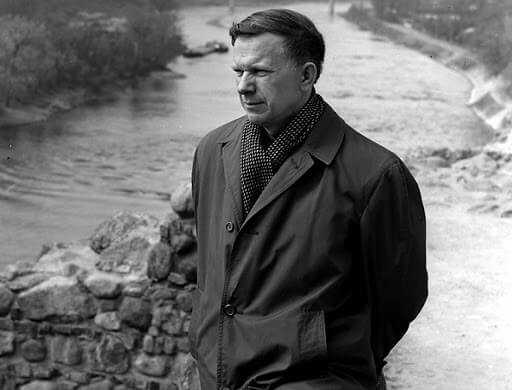


1939
School
He was born on June 19, 1924 in a peasant family in the village of Bychki, Ushachsky District, Vitebsk Region. He was fond of drawing since childhood. He graduated from 8 classes of a school in the village of Kublichi, then studied at the sculptural department of the Vitebsk Art College (1939-1940), which he left due to the cancellation of scholarships [8], and at the school of the Federal Law School (until May 1941). In June 1941, externally passed exams for grade 10.
19391942
War
Drafted into the army in the summer of 1942, he graduated from the Saratov Infantry School. In the fall of 1943, he was awarded the rank of junior lieutenant. Participated in the battles of Krivoy Rog, Alexandria, Znamenka. During the Kirovograd operation, he was wounded in the leg and stomach (mistakenly recorded as dead); events after the wound served as the basis for the story "It Doesn’t Hurt the Dead." At the beginning of 1944, he was in the hospital for three months. Then he participated in the Iasi-Chisinau operation, the liberation of Romania. With the army he went through Bulgaria, Hungary, Yugoslavia, Austria; senior lieutenant, commander of a platoon of regimental, then army artillery. About the war in the book of memoirs, "The Long Road Home."
19421947
Demobilization
It was published in 1947, worked in workshops, as well as in the editorial office of the regional newspaper Grodno Pravda (until 1949). In the period from 1949 to 1955 he again served in the Soviet army, in 1955 he was finally demobilized as a major. From 1955 to 1972 he again worked at the Grodno Truth. Since 1959, a member of the Union of Writers of the USSR. In 1972-1978 - Secretary of the Grodno branch of the Union of Writers of the Belarusian SSR. Bykov’s name appeared on the list of Soviet writers who signed the letter to the editorial office of the Pravda newspaper on August 31, 1973 about Solzhenitsyn and Sakharov, but he himself later denied his participation in this letter.
19471987
Deputy
It was published in 1947, worked in workshops, as well as in the editorial office of the regional newspaper Grodno Pravda (until 1949). In the period from 1949 to 1955 he again served in the Soviet army, in 1955 he was finally demobilized as a major. From 1955 to 1972 he again worked at the Grodno Truth. Since 1959, a member of the Union of Writers of the USSR. In 1972-1978 - Secretary of the Grodno branch of the Union of Writers of the Belarusian SSR. Bykov’s name appeared on the list of Soviet writers who signed the letter to the editorial office of the Pravda newspaper on August 31, 1973 about Solzhenitsyn and Sakharov, but he himself later denied his participation in this letter.
19871997
Border
Since the end of 1997, he lived abroad in political emigration - at first, at the invitation of the PEN Center of Finland, he lived in the vicinity of Helsinki, then, having received an invitation from the PEN Center of Germany, he moved to Germany and then to the Czech Republic. He returned to his homeland only a month before his death. Repeatedly criticized Alexander Lukashenko; He believed that for Belarus, an alliance with the West rather than with Russia was preferable.
19972003
Death
Grave of V. Bykov at the Eastern cemetery of Minsk. He died on June 22, 2003 at 20 hours from a malignant tumor of the stomach in the intensive care unit of the Oncology Hospital in Borovlyany, near Minsk [13]. He was buried in the Minsk House of Writers according to the rite of the Greek Catholic Church; the writer's coffin was covered with a white-red-white flag [14] Template: Inaccessible source. He was buried at the Eastern cemetery in Minsk.
2003